The beginning
The advent of murder hornets in Washington State, my native clime, brought up a faint buzzing about honeybees facing threats in the past. This prompted me to explore honey production data as a reflection of the presumed plight of the honeybee.
“The murder hornets are coming!”
“Murder hornets” have been discovered near the northern border of Washington state. They earned this moniker not for the danger they pose to humans, but because they decimate other bee colonies in a somewhat grisly fashion. They pop off the heads of their victims, bring the heads back as a feast for their young, and later return to the now uninhabited hive to collect the honey. These are certainly not the neighbors our honeybees need! What is going to happen to our honeybees if these invaders aren’t controlled?
“How are Washington honeybees faring now?”
Examining honey production could be a good way to look for answers to that question. Since 1987 the USDA has been tracking honey production throughout the United States**. There is a great diversity of climate and area between states. Pounds produced per colony allows comparison of disparate state honey production. On average Hawaii produces the most honey per colony and Maine the lowest. Washington also comes in below the national average, ranking 23 out of the 33 states included in the survey.
A national snapshot
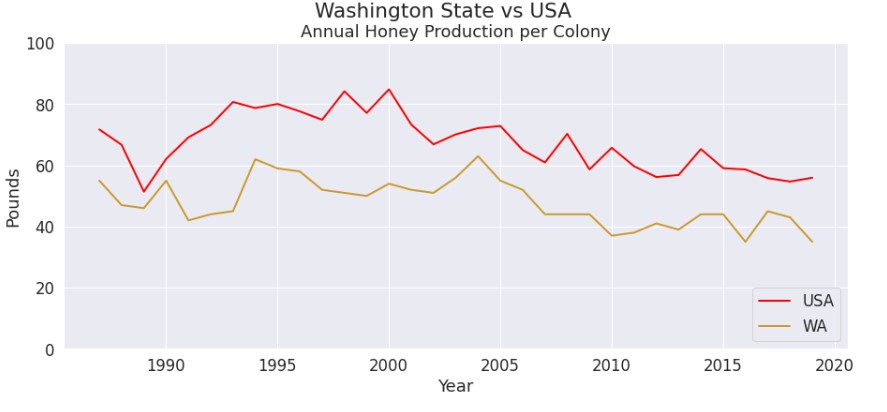
In 2004 Washington reached it’s maximum at 63 pounds of honey produced per colony. Washington’s historic low of 35 pounds per colony was reached in 2016, and again in 2019. This measurement is useful for comparing to our neighbors and certainly of high interest to beekeepers. However, it does not give a complete picture of Washington’s honey output.
A look at correlation
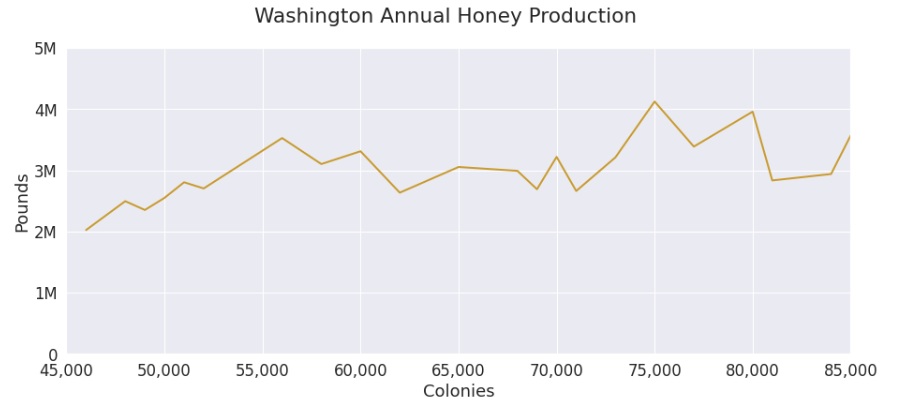
There is a positive correlation of 0.56 between overall honey production and the number of colonies. As can be seen there is a roughly upward trend for both. The record high of 85,000 colonies was set in 1991, and the 2019 count is not far behind. Even so honey production for 2019 is as low as it has ever been. Outside influences need to be considered.
Threats to honeybees
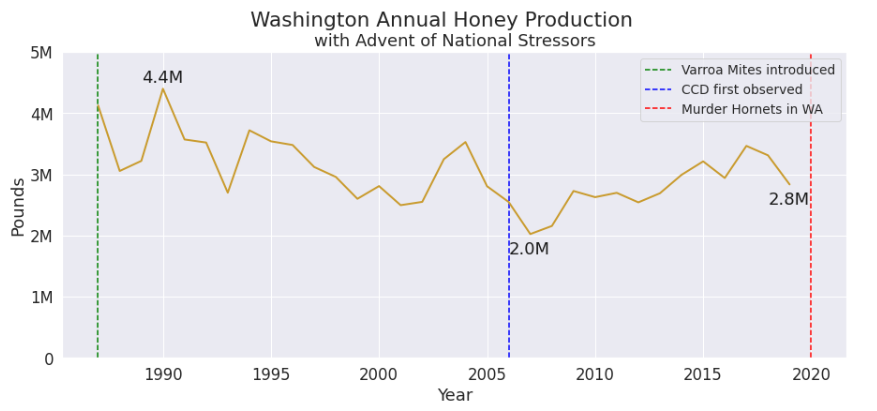
In 1987 varroa mites first appeared in the United States. If unchecked a varroa mite infestation will kill a colony in just two years. According to the USDA varroa mites continue to be the biggest threat to the health of honeybee colonies. Loss of some colonies over the winter is an expected part of beekeeping. However, in 2006 a phenomenon of hives apparently abandoned by worker bees was observed; colony loss was occurring on far larger scale than in the past. According to the USDA Colony Collapse Disorder, as it is now known, remains the most common cause of colony loss. The origin of CCD are unknown, though it is speculated that the pesticides used to combat the tenacious varroa mites may be having unintended consequences. In 2016 Washington State University noted that beekeepers were losing more than twice as many colonies as prior to CCD. It takes time for new honeybee colonies to become established and be productive.
“Really, how are the honeybees?”
Washington beekeepers, as well as their counterparts in other states, face an ongoing challenge to keep their honeybees alive and healthy. WSU is standing beside beekeepers, looking for innovative ways to help honeybees survive. Varroa mites and Colony Collapse Disorder have increased the difficulty of beekeeping over the past 30 years. With murder hornet invasion possibly beginning, the outlook isn’t good for our honeybees.
Other useful information
**Years are “marketing years” as defined by the USDA. Data is from beekeeping operations with five or more colonies. Thirty-three states have participated in the USDA honey production survey every year since 1987. Thus, “USA” numbers are a reflection of only these participating states. Actual national honey production may differ.
Find my raw data here: Raw_Honey
Get your own data from the USDA here: USDA_Data
Take a peek at my code here: Honey_Notebook
Eat honey for it is good; honey from the comb is sweet to taste.
Proverbs 24:13 paraphrase